Monday, March 26, 2007

On a more personal note...

I have been instructed to post something more personal this time, and so I’ll comply since I’m about to be out of pocket for a while. The last few weeks have been consumed with meetings, lectures, and preparing midterm essays, so there really isn’t a lot that’s too interesting to tell. I have figured out my classes and arranged an independent study in lieu of next semester’s cancelled course. I haven’t gotten more interested in my two compulsory courses. I have, however, made a few side trips that I thought you might find a little more scintillating than the details of my lectures.

1. The Apartheid Museum. This museum is a remembrance of all the factors which combined to create apartheid: pass laws, white fear, the works of Nelson Mandela and Desmond Tutu, the Soweto Student Uprising, etc. If you aren’t so good on your South African history, here is a link to the Wikipedia site on apartheid. It would really help you in understanding what I’m doing this year. Anyway, I’ve been to the Apartheid Museum twice now, both times for two hours, and am still only about 2/3 of the way through the museum. I like to read everything—you know me. Here are some pictures of the museum.


The pillars of post-apartheid South Africa. Not pictured are several others including reconciliation and truth.


Admission to the museum--you enter through the "white" and "non-white" entrances

An example of a South African identity card. Note that the woman pictured isn't just black, she's identified as Swazi as well. This is because blacks couldn't even all live together--they were forced into "homelands" of like tribes.


The definition of apartheid--"the system of segregation or descrimination on grounds of race inforced in South Africa 1948-1991."

2. The Hector Pietersen Memorial. Hector Pieterson was the first student killed in the Soweto Student Uprising (click for link) of 1976, which marks the beginning of black resistance to apartheid as well as state violence in dealing with black resistance. The memorial is dedicated to the student uprising and discusses the resistance of blacks to the state mandate of education for all students in Afrikaans, the language of the oppressor. It was really, really interesting for an educator.


Picture of Hector Pieterson being carried by another student and followed by his sister, Antoinette Sithole.


Marker placed by Nelson Mandela


View of Soweto from the Memorial


3. This weekend, I visited Calvary Methodist in Midrand to participate in the Manna and Mercy course offered by the pastor, Alan Storey. The course serves as a brief introduction to the Bible and provides a framework for understanding and interpreting scripture: that God desires a giving and forgiving people. Anyway, we discussed a lot about the context of scripture—things that the peoples who developed the scriptures would have understood just by being in their context. For example, the number 40 was not understood as a number, but the symbol for “a lot.” So, 40 years in the wilderness meant a lot of years, not necessarily 40 exactly. Also, the “rod” was a pointer by the rabbi used to help the congregation follow the scriptures. So, “spare the rod, spoil the child.” As a result of failing to seek out context, we fail to understand scriptures correctly. Very interesting!

4. For worship Sunday I attended Calvary for the early service. Calvary is a multi-race, multi-class church in Midrand, the halfway point between Jo’burg and Pretoria. The church has lots of ministries for the disadvantaged in the Midrand community and works toward active understanding of social justice issues within its own congregation. It reminds me of my own Highlands UMC in Birmingham. After attending the early service at Calvary, Alan took me to Ebony Park Methodist where he was preaching for their service. EPM is a more traditional African church with a service entirely in Zulu and members dressed in traditional Methodist attire (black suit with white shirt and red vest for men and red top with white collar, black skirt, shoes, and hoes for women). They danced and sang with vigor and welcomed me to their congregation by asking me to pray for them. It was lovely.

Finally, some views of Jo'burg from my various side trips. Hope you enjoy!

I love this sign! It's for Cell C and it's HUGE!

I live near the white tower, which is on the Wits campus.

They have great sunsets here--which leads to the question whether or not I am shaving years off my life breathing in all this smog!


So, I’ve had a good few weeks, despite papers on epistemic paternalism and the frameworks of human rights in light of shifting conceptions of human identity. On Wednesday I leave for Cape Town to visit Jon David, a friend from Birmingham who is also on a Rotary at University of Cape Town. We plan to live it up for a couple of weeks, so I won’t promise a blog post during that time. But I promise to include installment two of “cultural amalgamation issues” upon my return, so keep those thinking caps on. I will also promise pictures.

I love and miss all of you, have no doubt. I covet your emails and pictures and facebook messages. Thanks for all of your support. On a personal note: a belated Happy Birthday to my Uncle Denny! Congrats to Rebecca and Charles on their marriage! Congrats to Ben Marsh on becoming a Fulbright Scholar! I joy in your celebrations, even when I’m not around to hug you in person.

Wednesday, March 21, 2007

Public Holiday!

Hello, friends! Today is a public holiday in South Africa, and a great one, at that. Today is Human Rights Day, intended to commemorate the apartheid struggle and to bring light to every day issues of human rights. In honor of this important day, I wanted to share with you the first two verses of a favorite hymn of mine and my family’s. Hope you enjoy it!

This is My Song
Words: Lloyd Stone, 1943
Music: Jean Sibelius, 1899
Copied from The United Methodist Hymnal

This is my song, O God of all the nations,
A song of peace for lands afar and mine.
This is my home, the country where my heart is,
Here are my hopes, my dreams, my holy shrine
But other hearts in other lands are beating
With hopes and dreams as true and high as mine.

My country’s skies are bluer than the ocean,
And sunlight beams on cloverleaf and pine;
But other lands have sunlight too, and clover,
And skies are everywhere as blue as mine.
O hear my song, thou God of all the nations,
A song of peace for their land and for mine.

Human Rights Day is a really important day in South Africa which is used as further catharsis in the painful journey through and out of apartheid. Too bad the US doesn't have a similar day, don't you think? On this Human Rights Day, remember not only the importance of respecting the human rights of those in other lands but also the every day acts that honor or besmirch human rights in your own life.

Wednesday, March 14, 2007

Cultural Amalgamation Issues

I realize that there are some of you who read this with your children, and for those of you I’d like to suggest that you screen this before reading it together—the rating for this post is mature audiences only. I promise to post pictures soon for the Brents and Kyles of my readership!

The issue of multiculturalism comes up a lot in South Africa, as I’m sure you can imagine. At Wits alone, we have Muslims, Hindus, Jews, Christians, Atheists, Blacks, Whites, Indians, Coloureds (a term meaning mixed-racial and also representing a distinct cultural group in the Eastern Cape), Zulus, Sothos, Xhosas, Afrikaaners, British, etc., etc. There is no way to go out your door and know who you will see that day in most instances. We are constantly confronted here with the issues that face a multicultural society. As a result, there is a lot of debate about how society as a whole should handle these differing influences. A friend in one of my classes rightly called these quandaries “cultural amalgamation issues.” I wanted to present to you what we’ve been talking about in Human Rights class as a set of questions first and then in a second installment, I’ll discuss what we have concluded in class. (I know, I know, I’m being a teacher again. It’s in my blood, what can I say?)

1. When in a multicultural society, who should assimilate?

To elaborate on this, let me give a few examples. I think I’ve made some of the cultural influences of South Africa clear, but a quick and dirty explanation would be that South Africa was originally populated by many cultural groups, most of them what is considered black and was colonized by two main cultural groups, both of which were what is considered white. So, there was a blending of a traditionally “African” worldview (this is a VERY broad generalization) and a traditionally “European” worldview (again, broad). These two distinct worldviews come into conflict in many ways due to misunderstandings of each other’s beliefs, customs, and behaviors. One example is this: until recently (and still sometimes) when a person from a particular black culture would come to be interviewed for a job, he or she would insist on sitting on the floor as a sign of respect. Who in this case should assimilate to the other’s practice? Should anyone? An assumption inherent in colonialism was that the colonialised culture should assimilate.

2. Who decides which practices are right and which are wrong?

In several African cultures, there is an embracing of what many Westerners would consider to be misogynistic views. It is customary for the wife to bow to the husband as he is served, to have no right as to when conjugal acts occur, to prepare the affairs of the house (including all of the children), and not to be educated. Please note here that I am not suggesting that in one cultural group all of these events occur, simply that they are common throughout African cultural groups. Even in relatively “metropolitan” households, a son is still named “The one we have waited for has arrived,” even though there are already multiple daughters in the family. Most Westerners would consider these practices to be clearly degrading to women. How do we determine whether or not a cultural practice should be contested? Which values should be used—those of the culture or those of the “rest of the world”? Since these examples are “affairs of the home” and “more difficult to determine on a group basis” (we’ll flesh that out later), let me diverge to an example which you may find to be less in the grey area.

There are several African cultures which practice the ritual of “Female Circumcision,” also called “Female Genital Mutilation” in some groups (not within the cultural group performing the circumcisions). This practice involves the excision of the clitoris and sometimes portions of the labia minora and labia majora, rendering the female unable to experience sexual stimulation. It is understood that this ritual originally occurred to guarantee the virginity of a woman at her marriage as well as to discourage female promiscuity. Regardless the reason, it is considered a rite of passage and is staunchly defended on cultural grounds by men and women in the cultural groups who perform the ceremony. Is this practice categorically wrong? What if the woman chooses to be circumcised? Whose values do we use to judge? On what basis do we condemn? Health? Mysogyny?

As you can see, there are many slippery slopes when it comes to the successful mixing of cultures, and decisions made must be made rationally and soberly. I’d love your thoughts on this topic, whether by email or comment. If you want to email but don’t mind me posting part of your response anonymously, let me know. Since part of my job here is to educate, I think I ought to use this forum to do so.

Wednesday, March 07, 2007

Africa time

I have thought about posting several times this week but haven't done it because I feel as if I don’t have anything to talk about. It’s the first time that I’ve begun to feel not only settled, but even a little bored! But more than that, I’ve been frustrated. Then I realized that the whole reason I have a blog is to let you know what’s going on with me, and why not do that even when what’s going on with me is neither entertaining nor extremely upbeat? So, here goes.

As you know, I do not have internet in my room. Living in West Campus Village is lovely except for that. I have to go to the lab in order to get internet, and then it’s excruciatingly slow. For those of you who are interested, that’s because there’s a huge bandwidth monopoly here. The university ends up paying out the nose for internet and as a result makes it generally not fun for us to use. This would be fine if all I had to do was respond to you wonderful peoples’ emails. Unfortunately, I have to do some research at some point—shocking? So downloading pdf files or anything else becomes near to impossible. Thus, I have decided that it would be best to move to International House. Unfortunately, IH has few openings and the people in charge tend to “lose” your application (does this sound familiar—are you having flashbacks yet? I am). As a result, I have spent the last two weeks talking to 10 different housing directors and basically running in circles to no avail. I do, however, have one housing director (sadly the one for IH) who asks me for presents a lot. Gross.

In addition to this, I have been having trouble with my course set-up. As I’ve told you, I am not in the master’s program, which is where I should have been placed. Instead, I’m taking courses at the Honors level. This is not terrible except that two of the courses are entirely remedial for me. We’re talking about quantitative research—seriously? I’ve done this since Psych 101. So, I get bored. In the Hons. Program you take two mandatory courses and then get to choose two electives. I love the first elective, which is Human Rights—I’ve told you about how wonderful it is. The second course was supposed to be Democracy in Education, but it has been cancelled! This basically means that I’m wasting my time right now because if I can’t take that second course, then there’s no reason for me to complete the Hons. Degree which will be useless to me in the States. This all adds up to a lot of frustration. But I’m going through the “proper channels” and trying to arrange an independent study. I’ll keep you updated on that.

This may not seem to you to be a lot of frustration, and that’s probably because when you have a problem, you go to the source and you fix it. To help you understand my situation, let me give you a few examples of my interactions here:

Going to the bank to pay for my language course:

Lisa: Hi, I need to link my account for a transfer on the ATM.
Lady at desk: Well, we can’t do the transfer, but you can do it on the ATM.
Lisa: Right, good.
Lady: May I have your passport and debit card?
Lisa: I don’t carry my passport with me, but I have my ID card and my debit card and I can tell you my debit card number (thinking all the while that a North American passport could go for about R20.000 on the black market).
Lady: No, I need your passport.
Lisa: Well, I can give you my ID card and tell you my passport number.
Lady: No, I need your passport. I can’t do it without your passport number.
Lisa: Well, I can tell you that, I just don’t have the passport here.
Lady: Then we can’t complete the transfer.
Lisa: You absolutely have to have the passport?
Lady: Yes.
Lisa: Ok, well (really reluctantly) thank you.
Lady: Pleasure!

No. Not a pleasure. In fact, that’s the definition of NOT a pleasure.

Going to check on my course registration

Lisa: Hi, my second semester option didn’t show up on my registration and I was just wondering if this was a problem.
English faculty attendant: Umm…I don’t know…No, I’m sure it’s not a problem.
(TWO DAYS LATER)
Lisa: Nazir, I was just wondering…I already checked with the faculty office, but my Democracy course didn’t show up on my registration. Is this a problem?
Nazir: Oh, yes, definitely. In fact, I think they’ve cancelled that course. They didn’t let you know?

No, they didn’t.

So, you’re beginning to get an idea of what I’m dealing with. No one knows the answer, but they’ll gladly make things more difficult for you. Or, they’ll send you to someone else who doesn’t know and who doesn’t even have any idea what your situation is. It gets old.

This is not all to complain, it’s just to share with you some frustrations. I went to a very small college for undergrad, and frankly it was very student-centered. I worked in housing. I would rather DIE than work for housing here. I can’t even imagine! All I have to say is that between my dad, Dana Bekurs, Deb Sells, and Kathy Kano, we’d have this place ship-shape if I were in charge! Well, ok. If Daddy were in charge. As you can tell, this just isn’t what I’m used to, and it does get frustrating. I keep remembering Stewart and Terry reminding us of "Africa time" last year. I've found that for me, Africa time is not frustrating when you're in the country. But when you're in the city and still have to get things done, it's a killer. It’s the little stressors that get you, you know?!

Sorry that this week’s update isn’t more upbeat, but I knew that you’d be just as glad to share in my trials as in my exultations. I do have some exultations, though. Katy, some of Katy's English friends, and I went to a restaurant that serves all kinds of game meat on Sunday and it was a treat. Tomorrow I'm going out with some new friends (Americans, but with the goal to meet other people). This weekend should be a fun one spent with Lynne and Peter, so that should help a lot. All in all, life is still very good, just a little unnerving sometimes. Hope you are all having stress-free weeks. Love to you all.

Sala hantle (stay well).

Saturday, March 03, 2007

Special everydays

So this week obviously hasn't been as exciting as last week (who can top Cape Town, the African look-alike of my favorite city, San Francisco?!), but it has been nice all the same. I have had some special everydays, by which I mean that nothing incredible happened, but it was still special. I think that any good week should be filled with special everydays. So, let me fill you in on three:

1. On Tuesday I began my SeSotho class. To answer the obvious question, yes, Sotho is an ethnic group in South Africa. So, why SeSotho, you ask? Well, the Se before Sotho denotes language. Zulu and Xhosa (said with an initial click that I can totally say) also do this, adding Isi- to the rest of the word. So, I have begun SeSotho. I can now greet you, tell you my name, where I live, my age, my cell number, my birthday, and that I'm not married (some of you are very relieved by this, I know). Anyway, I have to study a lot because the sentence structure, etc. is very different than English. So the first special everyday came on Wednesday when I greeted my Lesotho friend Isaac in SeSotho and he then made me do it for Eunice and Dumisani who both maintain that I speak exceptionally well for a white person from the States. Obviously, it made my day! I am now doubly excited about studying SeSotho and am determined to be the best Southern-American-accented SeSotho speaker around.

2. On Thursday, I got back from SeSotho and was tired, but still had to eat dinner. I walked over to see Pascalia and she immediately insisted that I come in, as she and Janet were braaing meat and watching a South African soap. Not only did she feed me some wonderful braai, but she also made the traditional African dish, pap! Pap is much like grits, but without any of the fancy schmancy things we might add to it like salt or butter or cheese. It's also much smoother than grits. You eat entirely with your hands (they say it doesn't taste as good with a fork), and you roll the pap into little balls. Any of you who ever ate sack lunches at elementary school would be good at that--think bread balls. So, we sat and watched this soap about a woman who is a South African doctor whose mother is possessed and she has to decide between Western medicine and African beliefs, and ate our dinners. It was a very special everyday.

3. Last night, Katy, Ursula and I went to see the Drakensberg Boys Choir in their farewell concert before they leave for the States for the American Choral Directors Association (ACDA) convention in Miami. I know that some of you may be going to ACDA, and if so, be sure you don't miss this opportunity. These boys are incredible! They did a version of Bohemian Rhapsody, some Ravel, two new pieces by a South African composer named Martin Watt, some traditional African music and dancing, and a great version of the Star-Spangled Banner. They were really, really wonderful. Want to see them? Well, you're in luck because they're touring the country. You Birmingham folks don't have a show, but there is one in ATL and one in Nashville! Here is the website: http://www.dbchoir.info/. I'm telling you, you won't be disappointed! That special everyday made me excited about all the special everydays to come here. There's always something new and exciting to do!

Love to you all! Hope birthdays were happy this week. Oh, and props to Lenor for the Pictures of Alabama postcard (dude, that thing had a green light on Vulcan--how old is it?!), and Carrie and Donnovin for the pictures over email! I love hearing from you!

Tuesday, February 27, 2007

Cape Town!

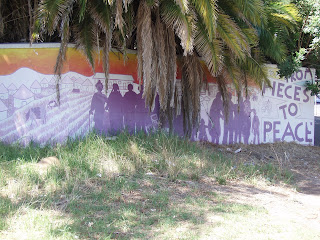
On Friday I flew to Cape Town with three of the other Rotary Ambassadorial Scholars from Jo’burg for an orientation conference. The conference included all of the Rotary Ambassadorial Scholars in southern Africa as well as a few African outbound scholars. I had been really excited about this opportunity both because I was really excited about getting to visit Cape Town and the chance to meet all of the other scholars. It turns out that this year’s South African scholars are mostly Americans with a few other nationalities here and there, including German and Swiss. We gathered at the Mountain Manor Backpackers Lodge at the base of Table Mountain and began the day with a light lunch. Lunch was a treat because it was brought by the Cape Town scholars of which my friend Jon David is one, and it was great to see him after a few weeks—we both had lots of stories to tell about getting settled in. Before we got started, some of us did some exploring and found this wonderful mural:

After lunch and socializing we went to the Cape Regional Chamber of Commerce for a talk about the South African economy. Here are some highlights: 70% of Africa’s electricity is produced in South Africa; Gauteng Province (where Jo’burg is located) makes up 34% of SA’s GDP; Cape Town gets 1.6 mil visitors/year; SA has a 25% unemployment rate; Namibia is 85% dependent on the SA economy; SAPP, the South African Paper and Pulp company, supplies much of the US’s paper supply.

The day culminated with a walk up Lion’s Head, which is across from Table Mountain. To get you oriented, here are a few pictures.


Table Mountain--see, it looks like a table!


Cape Town from the base of Lion's Head


Table Mountain from Lion's Head

The bay and more of CT from Lion's Head

Me and Jon David climbing Lion's Head. Who took this picture and didn't tell us that Jon David's eyes were closed?! Shame.


A parasailing trip we saw as we hiked up Lion's Head. Jon David and I put that on "the list" for when I come to visit. Katie and Mommy, should we put that on your list?

The entire group in the cave at the top, drinking champagne. Thanks, Trevor!


We climbed up the peak and had champagne and snacks in a cave near the top. We then began our descent to the surprise drum circle Trevor Wilkins (the illustrious coordinator of the weekend) had planned for us. We played drums and generally had a good time while the sun set in front of us over the Atlantic Ocean (yes, I thought about you all so far away!)


Drumming with our drum master--getting "crazy like him"

The entire group drumming with Table Mountain in the background

Next was dinner at Trevor and Liz’s, which was lovingly prepared by Liz. It was wonderful, and a great chance for us to chat with some new friends. Ben (Ole Miss) and I spent our evening describing to Aadila (South African outbound to San Diego) the Southern fascination with football. We decided that she probably just needs to marry a “footballer.” She was excited to hear about the customs and wants to come see it in person when we return to the states. I don’t think I’ll take her to a BSC game…but maybe Ben or Jon David can take her to Ole Miss or UA.


The following day was a long day of meetings about Rotary. We learned a lot about the programs with which we can be involved, what our finances will be, what Rotary’s expectations of scholars are, etc. It was a generally informative and very interesting day. I thought you might like to know a little about the SA legal system (which is only 12 years old), so here are some interesting points: there is a Constitution much like ours, a Constitutional Court, and a house of Parliament; abortion, gay marriage, and felon suffrage are legal while corporal punishment and capital punishment are not; and only 2% of prisoners in SA are women! During dinner on this day, we had yet another chance to explain the South to our friend Bianca who will travel from Namibia to Houston for her Rotary year. She was so confused about the white clothing rule. Anyone know a good reason for that other than “just because”?


Ilya, Elliot, Lisa, Ursula, Ashley, Charlotte, and Priya enjoying "sundowners" at the Royal Cape Yacht Club

Our final day in Cape Town began with a dragon boat race—this is exactly what it sounds like—along the Victoria and Alfred (V&A) Waterfront. We even saw seals!! You can imagine where my focus was…Here are some pictures of that event.


I'm in the purple shirt. If you look carefully you can see the dragon painted on the side of the boat.

Here's a better view!


Aren't I cute? And doesn't Ilya look scary?!


We're saying "winners," but that was a total lie. Sorry, Christopher.

Next we drove out to Stellenbosch to the Rustenberg Wine Estate whose dairy herd is attended to by Trevor’s son-in-law. The estate had a beautiful English garden of which I promise to post pictures once I receive them. We drank wine and had a braai (South African barbecue) and generally enjoyed the beautiful scenery. Check it out.


Aadilah (Durban), Lisa, and Amy (Houston, TX) at the Wine Estate. You can't see the dead cow in the background, which is good, but I still felt I needed to tell you about it.


The entire scholars group

Next we traveled out to Kirstenbosch Botanical Garden for a concert on the green. Kirstenbosch is located at the foot of Table Mountain. Pictures of that to come. Afterward, the group was hungry and we headed out to Primi for a pizza dinner. Elliot (CT scholar) and I shared the Austin Powers pizza (yeah, baby) and discussed our plans for the year. Primi serves long island iced teas in teapots—what a great idea! I always think I should go into the restaurant business…This was a great way to wrap up the weekend and talk with all of our new-found friends. We now all have somewhere to stay no matter what city we visit, and people to take care of who will be going to San Diego and Houston! It was a great, celebratory event and wouldn’t have been possible without the hard work of Liz and Trevor Wilkins and several other key Rotarians. We were so blessed!


Today I return to the real world of school and work. Maybe by tomorrow I’ll have caught up on my sleep from the weekend and can begin to get some good work done (my dad’s email signature rings in my head—“now get back to work!”).


Love to you all and to your families and friends. Know that I miss you and love you. Would love to see some pictures of all of you—even if they’re boring! Oh, and happy belated birthday to Stephanie and early birthday to Peter Ward and Lynn Miles! Lynn, make Gail take you out somewhere fun.

Tuesday, February 20, 2007

My Traitor's Heart

I just finished reading an extremely honest book that I'd like to recommend to all of you looking for a good read and thinking, "there must be some way for me to catch up with my South African history and knowledge." It's called My Traitor's Heart, and it is written by Rian Malan, descendant of former Prime Minister D.F. Malan.

The Malan family are Afrikaners, and so Rian's understanding of South Africa is filtered through an inevitably supremacist ideology. D.F. Malan was the first Nationalist Prime Minister, a member of the entirely-Afrikaner party. He was one of the first and "best" architects of apartheid, a strong believer in socialist and Calvinist world order--in his own view. Says D.F. Malan of the then-future of South Africa and apartheid, "Socialism has done an invaluable service to humanity, and not the least to Christianity itself, by turning its searchlights on the evils of the existing system. We hope and pray that Christianity and socialism may be so guided in their future development that the deep yearning, the widespread movements, and even the passions and the violence of the age may prove to be but the birthpangs of a better social world." Wow. A better social world through the oppression of the masses. In great honesty, many white South Africans will tell you that while the world might not have been better under apartheid, it was much certainly easier. Everyone was given a place in society and there existed an easily-defined code of conduct for every individual based on his or her race.

Rian Malan discusses his evolution as a liberal Afrikaaner who did not believe in the apartheid system and eventually moved to the States in order to avoid being drafted into an army with whose motives he didn't agree. After his return to South Africa, he was forced to face his paradox--the idea that he "loved" blacks, but could never truly "trust" blacks, due to his upbringing. He discusses this as the ideological problem central to most whites in South Africa--a want to love and an disability, though maybe not an inability, to trust. He grew up in scary times--the 1970s and 1980s when apartheid was at its worst and most violent. Here is a quote from one of my favorite parts of the book:

"In 1510, Portuguese Viscount D'Almeida came in peace, but the sight of his white skin and strange vessel struck terror in the hearts of Hottentots on the shores of Table Bay, so they killed him, and we've been slaughtering one another in fear ever since. Dawid Malan and the Xhosa slaughtered one another along the Great Fish River for sixty years, and then the Boers trekked into the interior, where they ran into the mighty Zulus. The Voortrekker leader Piet Retief approached the Zulu king Dingaan under a white flag, but Dingaan feared him, and murdered him and all his party. The Afrikaners never forgot Dingaan's treachery. After that, we always shot before we saw the whites of black eyes, and then, in 1948, we invented apartheid, to keep blacks so far away that we couldn't see them at all.
"At one point in the fifties, Nelson Mandela's ANC was willing to settle for sixty seats in the white Parliament. The Afrikaners feared black domination, though, and thought they could keep blacks down forever, so they spurned Mandela's humble demands and tried to crush his movement. Three decades later, Botha had second thoughts, and extended a tentative hand of friendship across the racial divide. By then, blacks were also contaminated by fear and hatred, so they struck his hand away, and we spiraled on down toward mutual annihilation. We always seemed to miss each other in the murk of our mutually baffling cultures and our mutually blinding fears."

Being from the Southern U.S., I understand this paradox. I can feel it in most of the interactions I have with people of other races. I hate the paradox, and yet can't always let it go, no matter how hard I try. Likewise, I know many who see the paradox from the other side around. We all have been brought up in such a way that we now have a want to love and a disability to trust. I am thankful to have found a book that put my difficulty into words in such an eloquent way.

This is a great and compelling read--you should easily find it on Amazon, if you're interested.

Monday, February 19, 2007

I promised pictures of my apartment, and here they are. Imagine that you're walking in the door, and I'm giving you the tour.


My kitchenette, on the left of the entrance.


Bathroom on the right. Don't you like my shower curtain and orange bath mat? And me in the mirror...


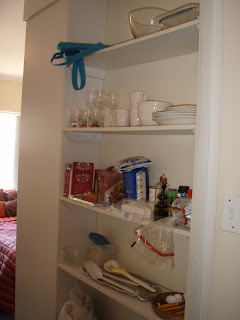
Pantry on the right after the bathroom.


Kitchen table and bulletin board next to the kitchenette.


I figured you'd wonder what was on my kitchen table. It's a Kenyan kikoy used as a tablecloth and a Madagascan placemat on top of that, both from Lynne and Peter. Here's a closer view.


And here is a really close view of the stitching. All of the stitching is done by hand--we have art like this in South Africa--and it depicts rural life in Africa. In this image you can see a woman carrying a baby and a basket and a man sitting on a rock.


My bed, to the right after the bathroom. Isn't the comforter that Lynne and I picked out beautiful? And I found pillows to match! Of course, the Africa map is there to stay--as usual! It is quickly acquiring new Xs. Sadly, Paris is the only European city I've visited which isn't included on this map. Otherwise, my entire travel experiences could be seen by the Xs on this map.

There is also a desk in this room, but suffice to say that I was too embarrassed to show it in its current state.

This weekend was a lot of fun, but mostly running around. Ursula and I went to Rosebank Mall on Saturday to pick up a few essentials and get our hair cut. I don't have a picture, but it's just shorter. It always looks essentially the same, anyway. Rosebank is large with around 100+ shops and is much like the Summit meets the Galleria with outside and inside shop entrances. While we were there we found this lovely street performer who painted himself pink and then would dance for a few rand. Ursula gave him a few and is obviously impressed.


Here he is dancing:


After Rosebank, we went out to Melville with Tamlynn, a Rotarian in my host club who is 23, as well. She's a lot of fun. Melville is essentially the 5 Points of Johannesburg--lots of bars and trendy restaurants. Some of the restaurants voted best in Jozi are in Melville, and it happens to be only a 5 minute car ride away from campus. So, we went to a bar called Cool Runnings which has quite the Rasta feel (obviously). We hung out and talked and had a generally good time.

Sunday I went to the Catholic church on campus with my Zimbabwean friends Janet and Pascalia. The service was very traditionally Catholic, but with the African tradition of processing to the front to give your offering. I love it! Janet and Pascalia are sweet and live on either side of my hall. They said that at home, their service would have included lots more singing, some dancing, and a lot of drumming. I was sort-of disappointed because there was no choir--sad. I'm going to have to look harder for a church with a choir. As my mother rightly pointed out, I haven't been not in a choir since I was 7!

After church, we hung out with Keegan, an old Ambassadorial Scholar for a while. Then, sadly, I had to study a little. It was brightened, though, by company of my friend Elizabeth who is from Botswana. Elizabeth lives at Wits full-time to get her diploma, but has taught in Botswana for years and leaves behind a 14, 10, and 4 year old. She misses them a lot. We decided to walk down the street to get some airtime for her phone and ended up walking past a man begging for change in the road. He looked terribly physically disabled and had great difficulty walking. As we walked back past, however, we saw him standing erect and walking normally out of the view of the oncoming cars. I was so disappointed by this! There are lots of people in Joburg who beg, and most of them because they are truly destitute. I was so disappointed that this person would be willing not only to exploit being destitute, but also to exploit those who really are disabled and do need help. Elizabeth said it best--"what a moron." How sad.

I got to experience an interesting phenomenon from a distance. We had a soccer match on campus between the Wits Clever Boys and the Kaiser Chiefs. Apparently there had been some violence the last time the Chiefs played, so they didn't sell many tickets, so we missed out on that. Regardless, it was quite an extravaganza from what we could see walking by. Everyone dresses in team colors and brings or buys at the game a large trumpet-esque instrument called a Vuvuzela. You can hear vuvuzelas from miles around!! (Side-note, our campus newspaper is called the Vuvuzela, as well. Almost like calling it the Bugle, I think.) There were women with braiis (barbecues) all around selling chicken and cold drinks to the revelers. I think there were around 5,000 people at the game, and there would have been more except that tickets were limited. Anyway, next time we will have to attend a soccer match. Sadly, the Chiefs won. Then again, when you have violent fans, you want their team to win, huh?

Today's class is Human Rights (wooo!!). Then tonight I think I'll open my cheap bottles of South African wine. Do I mean cheap wine, you ask? No, but SA wine is much cheaper than at home, and usually much better. What a deal.

Friday, February 16, 2007

A day in the life

If you haven't yet seen pictures, I posted them yesterday, so start from the bottom and then return to this post.


I realized that I haven't filled you in on a lot of the basics with my life here. So, here we go:


In the mornings I awaken at around 6:30 or 7 to the sound of the Hadada Ibis:


Ursula says they look like they're from Alice in Wonderland, and they do. I'm sorry there's not a point of reference for its size, but it's usually about 1 1/2 feet tall when standing. The feathers have a sheen to them that is really pretty. Unfortunately, they also call REALLY loudly "haaaa haaa haaaaa" very early in the morning and very late at night. This makes sleeping in difficult.

So, I awaken around 6:30 and realize that I am sweating a little. We don't have A/C (air con, as they call it here), so some mornings are better than others. I then shower and read for a while. Right now I'm working on My Traitor's Heart by Rian Malan. More on that when I finish it later this weekend! I then eat my breakfast of cereal (granola called Muesli with grains, almonds, and cashews), milk, and a banana. We finish the morning with a cup of Five Roses tea with sugar and milk. I'm becoming very British, yes?

After my breakfast ritual, I go down to the computer lab to update you and respond to your emails. I am really enjoying the freedom to do that! I then waste away the rest of the morning reading or playing guitar and then fix myself some lunch. The rest of the day is usually filled with errands. For example, the queue to buy notebooks is more than 15 people long every time I pass the bookstore. You can imagine that nothing gets done very quickly.

Class begins each day at 3:30 and lasts until 5:30. On Tues. and Thurs., I also have Sotho (say sootoo) class from 6-8. I will begin that course Tues. Sotho is the second most spoken language in South Africa and the official language of the Kingdom of Lesotho, one of two countries enveloped by South Africa. My friend Isaac who is from Lesotho is really excited about me learning to speak Sotho. No, there are no clicks in Sotho, but I'm sure I'll pick up some Zulu while I'm here, so don't worry.

After class, I'm totally exhausted, so I return to my room and make dinner. After dinner, a cup of tea is again required, this time as a stimulant to keep me up to a decent hour. I know it sounds lame, but you have to imagine that I spend most of my day walking outside in 30+ degree Centigrade weather in a city that has the same altitude as Denver. My lungs aren't quite adjusted yet.

Evenings are filled with reading and guitar and now scrapbooking, as my stuff from Turkey/Greece/Rome arrived in the mail yesterday. I now just have to figure out how to get pictures printed in South Africa...hmm... I have also been getting to know my Zimbabwean neighbors who like to sit and talk and have tea and ask me what's weird to me about Africa.

So that's my average day. Pretty boring, but I like it.

As for Rotary stuff, I haven't really started yet, but I need to get on it. There are five Rotary scholars here: Priya from California, Pierre-David from Canada, Desiree from New Mexico (I think), and Ursula who doesn't know where she's from (her folks live in DC, but she grew up in Cairo and Latin America...she went to Wellesley so usually we just say she's from Wellesley). I haven't met anyone but Ursula yet, but we're planning to get together soon. If we don't sometime this week, we'll all meet in Friday on our expedition to the Rotary conference in Cape Town! Our requirements are to make 10-15 Rotary presentations and to do some sort of service project. To learn about last year's project click on the Rotary Aids Walk link in the sidebar.

And now for some housekeeping. If you have a question you want me to respond to, put it in comments or email me. If you put it in comments, I'll answer it in comments because, as my teachers have always told me, if you're asking, probably someone else would like to know, too. If you ask in email, I'll answer in email. That's enough of that.

This weekend holds a trip on the Wits bus to the Rosebank Mall (a huge mall with two "movie houses") for shopping (mostly food) and wasting time. Sunday I am attending the campus Catholic church with my Zimbabwean friends. They were so shocked that there was no drumming at this Catholic church, on which they opined, "You hardly feel Catholic if there's no drumming!" Hmm...for all my Catholic friends, what do you think?

Keep well.

Thursday, February 15, 2007

If a picture's worth a thousand words...

I promised pictures, and here they are. Now I'll get busy taking some more.


Present from Lynne and Peter on my bed when I arrived--bath gel, etc., the book Rabble Rouser for Peace about my buddy Desmond, a beautiful card, and towels


The lake outside my "res"


My "res," West Campus Village and fountain in the lake


Me--see! I really live here!


The Senate House/Great Hall building featured in all of the Wits information

Me and Nelson doing the Madiba Shuffle. Can't figure out why it won't turn...


At Moyo for my birthday


Face painting from Moyo


A cricket Katy and I found outside Colleen's house. That's a 6" pen next to it for perspective. They call them Johannesburg Lobsters


Big 5 sand sculpture at the Durban beach


Ok, I even flipped this one in the viewer and it still won't work. You get the idea, though.


Beach with beach-goers at Durban. The surf was INCREDIBLY rough, but there were still lots of swimmers

Downtown Durban

I can verifiably say that I have NEVER had an award-winning cappucino at the Piggly Wiggly! Katy and I found this sign on the way to the Midmar Mile

Swimmers at the Midmar Mile. One of those little yellow caps is Katy. If you look all the way across the lake (Dam), you can see just how far they swam (a mile, duh).

So, I hope that you enjoyed the picture updates! I miss and love you all.